Chiropractic For Animals
Large and Small Animal Veterinary Chiropractic in Northern Ireland
Helen is fully qualified in animal chiropractic. She has undertaken the International Veterinary Chiropractic Association examinations which grants her access to the British Veterinary Chiropractic Association (BVCA) which is dedicated to promoting excellence in the field of Veterinary Chiropractic in the United Kingdom. She is also is a member of the Register of Animal Musculoskeletal Practitioners (RAMP). Helen has also completed advanced qualifications in Animal Chiropractic at Options for Animals in the United States and is a member of the Royal College of Chiropractors (RCC) in both the animal and human faculty. These organisations set high standards for their members who must adhere to a strict Code of Practice and Ethics.
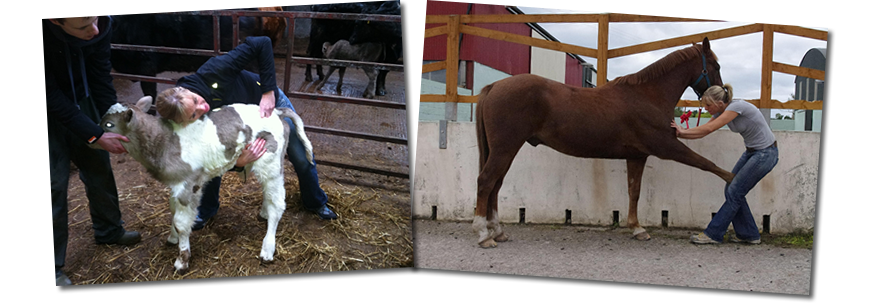
Helen is predominantly based at her bespoke practice located in Kircubbin, Co. Down, with facilities to accommodate both large and small animals as well as humans. She also has regular equine clinics at Dalways Bawn Livery Stables located on the outskirts of Carrickfergus and at Vumba Stables outside Lisburn.
What is Veterinary Chiropractic?
Veterinary Chiropractic is a combination of traditional human Chiropractic and Veterinary medicine which forms a unique profession that has recognition as a separate health care branch. It is a manual therapy, which can be used for many health and performance problems. It focuses on the biomechanical dysfunction of the spine and extremities and its effect on the entire nervous system throughout the body.
Veterinary Chiropractic treatment does not replace traditional veterinary medicine; however, it can provide additional means of diagnosis and treatment options for spinal problems as well as biomechanical related musculoskeletal disorders. Veterinary Chiropractic can often eliminate the source of acute or chronic pain syndromes rather than treat the symptoms.
Veterinary Chiropractic Treatment Can Be Used For
- Chronic musculoskeletal problems
- Acute problems such as tension or stiffness
- Prophylactic treatment to maintain fitness
- Maintain soundness in older animals
- Enhance performance ability of sport animals
- Arthritis in the older animal
- Post surgery rehabilitation
- As a complementary treatment for chronic lameness such as bone spavin, navicular syndrome or tendon problems in the horse as well as arthrosis, spondylosis or tendon problems like cruciate ligament in the dog.
Signs and symptoms
Animals with joint and muscular dysfunction may present with many symptoms, the most common of which is pain. Animals with back pain often express this in their posture or in their refusal to work.
The animal attempts to compensate to avoid pain or lack of ability to move a joint or muscle through its full range of movement and therefore as a result shifts weight away from the painful area and overloads other joints and muscles resulting in secondary problems developing such as arthritis.
Symptoms in a horse which may indicate pain or dysfunction
- Reduced performance
- Abnormal posture
- Snapping and pinning back its ears when being saddled
- Insubordination when being ridden
- The attempt to free itself by throwing its head back or up or by hollowing the back
- Swishing its tail and pinning back its ears
- Disobedience when jumping
- Difficulties with collected or lateral gaits
- Changes in behaviour
- Frightened or painful facial expression
- Sensitivity to touch
|
Symptoms in a dog which may indicate pain or dysfunction
- Reluctance to move
- Abnormal posture
- Disability to climb stairs or jump onto araised areas
- Limited performance
- Signs of pain when performing certain movements or being lifted
- The animal only lies on one side
- Disobedience when jumping
- Altered sitting position (so-called “puppy sitting”)
- Changes in behavior
- Frightened or painful facial expression
- Sensitivity to touch
|
This list of symptoms is certainly not exhaustive; however, it does demonstrate the many effects musculoskeletal dysfunction can have.
Download Vet Consent Form (PDF)
Click here to view testimonials for chiropractic on animals
|



.JPG)
.JPG)
.JPG)
.JPG)
.JPG)
.JPG)
.JPG)

.JPG)
.JPG)
.JPG)
.JPG)
.JPG)
.JPG)
.JPG)
